
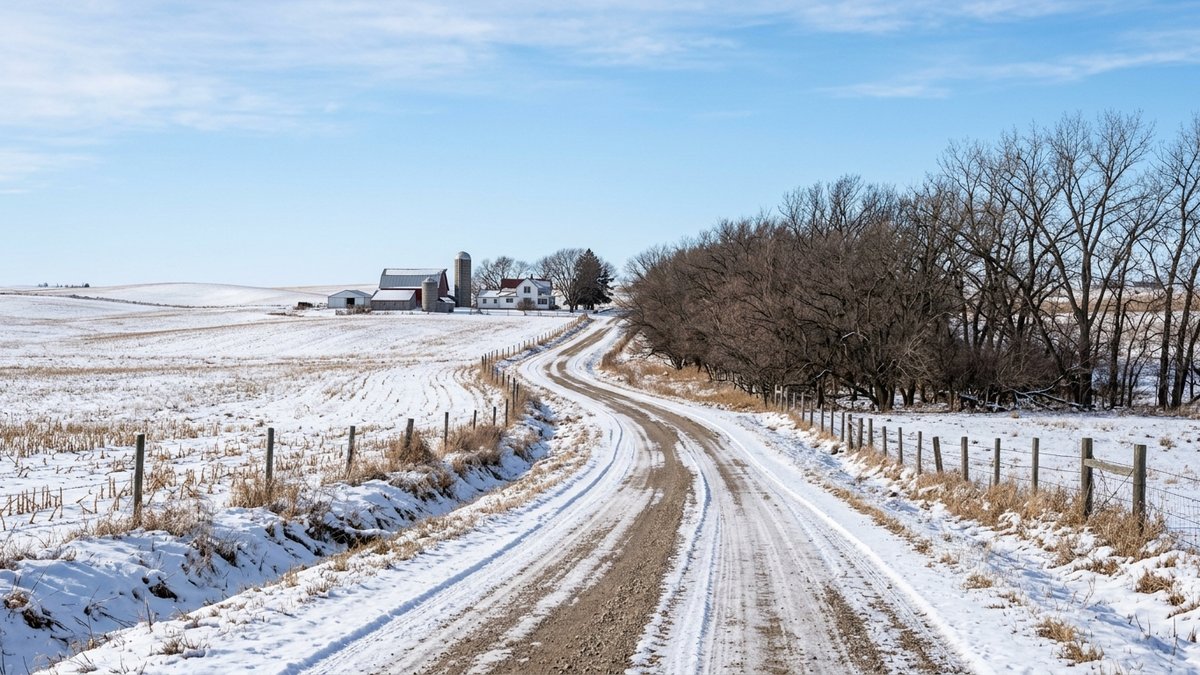
Why is winter road access part of the home decision?
Winter road access is not a side question for rural homes in South Dakota. It is part of whether the property fits your work schedule, medical needs, school or activity trips, deliveries, visitors, and ordinary errands. A home can have the layout, land, and price you want while the route into it creates a daily trade-off you did not plan for.
Start with the actual trip, not the listing map. Trace the route from the driveway to the first regularly maintained public road. Then ask what happens on a snowy or windy day. The answer may be different for a state highway, a county road, a township road, a private lane, or a shared drive. Do not assume that a road visible on a map has the same maintenance level as the road in front of a house in town.
South Dakota Department of Transportation points travelers to SD511 for current state-system road conditions. It can also carry localized advisories or closures that a county or tribe chooses to add, but it does not provide condition reports for every county- or township-maintained road. Check the live service for the covered route close to departure, then use the responsible local road authority for an uncovered public segment. Private drives, shared lanes, and the final approach still need property-specific answers.
For buyers relocating from a place with short paved trips, this can be one of the bigger adjustments when moving to South Dakota. Rural living may give you more room and a different pace. It can also mean building more time into winter travel and learning which access questions belong in the first round of property due diligence.
What should you map before you make an offer?
Map the whole route in both directions. Identify the property driveway, every shared or private segment, the first county or township road, and the state or local route you would use for the trips that matter most. Ask the seller or listing side to explain the route used in winter, but also compare that explanation with what you see during a visit.
If possible, visit at a time when the road surface and drainage are easy to evaluate. A dry summer drive does not settle how a gravel lane, low spot, hill, curve, or exposed stretch behaves after snow, ice, drifting, or spring thaw. You are not trying to predict every storm. You are trying to understand which parts of the route become the limiting factor and what backup plan you would need.
The first regularly maintained public road is a useful dividing line, but it does not make SD511 a condition source for every public segment. Use SD511 for state-system conditions and any localized county or tribal advisory it displays. For a county- or township-maintained segment without an SD511 advisory, check with the responsible local road authority; for private or shared miles, ask the people and organizations responsible for the property or road.
Bring the route into the rest of the home search. A buyer comparing acreages near Yankton, Vermillion, or another southeast South Dakota community should compare winter access alongside drive time, well or septic questions, internet, outbuildings, and the condition of the home itself. The access route is part of the property system, not a separate errand after closing.
Who maintains and plows each part of the route?
Ask for a clear answer for every segment. A public road may be maintained by a state, county, township, or other local authority. A private or shared road may depend on an agreement among owners, an association, a hired contractor, or a single owner. The name used for a road is less important than knowing who has the current responsibility and what that responsibility covers.
South Dakota law provides a narrow reminder that private-road maintenance is not something to assume. When a county agrees to maintain private roads under the cited provisions, it may set a maximum number of maintenance hours or miles. That does not tell you what will happen at one address. It does show why the parcel-specific arrangement matters.
Ask practical questions in plain language. Who coordinates plowing? Is the road plowed after every snowfall or only after certain conditions? Who pays for grading, gravel, culvert work, or snow removal? Are there gates, steep sections, or turnarounds that affect larger vehicles? Is there a shared-road agreement, and has anyone reported an unresolved maintenance issue?
Yankton County’s Highway Department offers one useful local example of the public-road layer. It lists county road maintenance, snow and ice removal, sanding, a snow-plowing map, and a snow-plowing FAQ. Another county may organize services differently. Use the relevant county highway department to confirm the road that serves the specific property instead of treating any one county’s information as statewide policy.
What documents and local checks should you request?
Request the information that shows how the access route is meant to work, not only a verbal assurance that the road has always been used. Depending on the property, that may include recorded access documents, a shared-road or maintenance agreement, association materials, notices connected to recent road work, and contact information for the person who handles snow removal. A title professional or attorney can explain how the recorded documents apply to your situation.
Use the appropriate local highway office for questions about a public road or its maintenance area. Ask whether the route is public, how the office identifies it, and where to find current notices or maps. If the route crosses a private or shared segment, ask the seller for the written arrangement and verify the parts that affect your daily use before your contingency deadlines pass.
It also helps to ask about the practical edge cases. Can emergency vehicles, delivery trucks, propane deliveries, or a moving truck use the route under normal conditions? Is there room to turn around? Does the road have a hill, drift-prone stretch, or surface that changes the vehicle you would use in winter? These are fit questions, not promises that any agency or service provider will respond on a certain timetable.
The Move to SoDak acreage guide and South Dakota relocation guide can help you keep access in the same checklist as other rural systems. For a specific property, bring the access documents and your actual travel needs to the people who can verify them.
How do you decide whether the access route fits your life?
Use a three-part before-offer checklist. First, route. Can you identify the full path to the first regularly maintained public road, and do you understand the portions SD511 can and cannot tell you about? Second, responsibility. Do you know who maintains and plows each segment, how the arrangement works, and what you would be expected to handle or pay for? Third, fit. Does that arrangement work with your vehicle, work schedule, household needs, deliveries, and comfort level for winter driving?
The answer does not have to be perfect access in every weather event. South Dakota winter travel can change quickly, and even main routes may carry advisories or closures. The useful question is whether you have clear information, a realistic routine, and an acceptable backup plan when conditions change. A rural home may still be a strong choice when the road is private or shared if the responsibility is documented and the arrangement makes sense for you.
Pause when something is unclear. An unclear road classification, unwritten shared-road arrangement, uncertain plowing plan, or route that does not fit your regular travel needs deserves more verification before an offer. Waiting for those answers is usually easier than trying to settle a maintenance question after you own the property.
If you are comparing rural homes in South Dakota and want help organizing the real estate side of the decision, contact Move to SoDak. Bring the location, route, property type, and questions that matter to your day-to-day life. A useful home search should account for the drive home in winter as well as the house you see on tour.
Frequently asked questions
Can I rely on SD511 to tell me whether a rural driveway is passable?
No. SD511 is useful for current public-road conditions, alerts, and closures. Confirm private drives, shared roads, and the final approach directly with the responsible owner, road group, or local contact.
Who pays to plow a private or shared road?
The answer depends on the documented arrangement for that property. Request the current maintenance and snow-removal agreement, ask who coordinates the work, and review the terms with the appropriate professional before you rely on them.
Should I ask the county about a rural access road?
Yes, when the road may be county maintained or you need to confirm its public-road status. Use the highway department for the county where the property is located, because practices and resources can vary by county.
What is the most important winter-access question before buying?
Ask who is responsible for every segment between the home and the regularly maintained public road, then decide whether that arrangement fits your real travel needs and backup plan.
Sources South Dakota Department of Transportation Winter Weather Hub · South Dakota Codified Law 31-11-45 · Yankton County Highway Department
Related South Dakota resources

Work with Michelle Maloney
Bring Michelle the town, property type, timeline, and the decision you are stuck on. She will help you compare Sioux Falls, Vermillion, Yankton, Tea, Beresford, Elk Point, and the Sioux City corridor against the way you actually need to live or sell.